CHAPTER 12: Distribution Center Planning Example
Impact of Changing Data Units: Chapter 10 demonstrates the changes that occur when the units of shipping data are changed from "cases" to "pieces" (individual units) when formulating a basic system plan for a distribution center.
Fundamental Transformation of the System: This serves as a practical example showing that the logistics system itself becomes entirely different depending on whether the data unit is "cases" or "pieces."
Importance of Planning: It is emphasized that differences in shipping formats (units) have a decisive impact on overall system design, including equipment selection and operational flow for the logistics center.
I. Introduction
-
Compliance with Numbering Systems: The drawing and table numbers used in this chapter are based on the numbers and sheet names (EX0-000) of the Excel analysis example "EX0" in Chapter 15.
-
Necessity of Assumptions: Since EIQ analysis results alone are insufficient for planning, missing elements are supplemented with hypothetical conditions.
-
Flexible Interpretation and Diverse Conclusions: Unlike mathematics, there is no single correct answer; the planning outcome varies among individuals depending on how data is read and conditions are set.
-
Three Elements of Planning by EIQ Method:
-
Iterative Method: If inconsistencies arise with other conditions during the planning process, established numerical values are flexibly changed and modified to finalize the proposal.
-
The "Good Enough" (Appropriate) Method: Fluid data, such as inventory volume, is treated as approximate values. Rather than sticking to overly strict figures, values that are "just right" and reflect reality are adopted.
-
Macro Perspective: The overall structure is surveyed from existing data to assemble the plan while envisioning the big picture.
-
II. EIQ Data
-
Basic Analysis Values: The data consists of 12 customers (E), 33 items (I), 1,678 pieces (Q) shipped, a total of 166 order lines (EN), and 37 types of inventory (ZI).
-
Inventory Status: Current inventory levels are unknown.
-
Estimation of Distribution Center Characteristics: Given the low number of order quantities and shipping varieties, combined with a total shipping volume of 1,678 pieces, this facility is estimated to be a "low-variety, high-volume" distribution center.
-
Utility of Data: While detailed materials (Example EX0-DATA) exist, the general situation of the distribution center can be grasped simply by checking the basic E, I, and Q data.
III. DC Scale (EX0-Radar)
-
Scale Calculation Results: The DC size was calculated as 41,490 B-DC size, and the DC scale was calculated as 204 B-DC scale.
-
Scale of the Distribution Center: Since the DC scale, indicated in B (pieces), is a small numerical value, this facility is judged to be a "small distribution center."
-
Unit Reinterpretation: While the calculated numerical values are the same as the "case" example, the unit has been changed from "C" (cases) to "B" (pieces).
-
Materialization of Physical Volume: The shipping volume of 1,678 pieces is equivalent to approximately 70 cases. Assuming 24 cases per pallet and 24 pieces per case, this equals 3 pallets—a volume that can be transported by a single 2-ton truck.
IV. Inventory Volume and Inventory Types
1. Assumptions for Inventory and Estimation of Warehouse Scale
-
Inventory Setting Assumptions: Since inventory volume is not provided, it is assumed to be "20 days of average shipping" as a necessary condition for the distribution center plan.
-
Calculation of Warehouse Scale: If the daily shipping volume is 70 cases, a 20-day supply totals 1,400 cases, estimating a warehouse scale of approximately 58 pallets.
2. Estimation of Inventory Volume (Max/Min) per Type
-
Estimation from Shipping Volume: Based on the daily shipping volume from IQ analysis (max 267 pieces, min 1 piece), the 20-day equivalent is calculated as inventory.
-
Calculation Results: The maximum inventory for a single item is predicted to be approximately 5,340 pieces (220 cases), while the minimum is approximately 20 pieces (0.8 cases).
-
Comparative Review: Since these figures are estimates from one day of EIQ data, it is recommended to verify them against actual monthly EIQ analysis results or current inventory ABC analysis results.
3. Method for Calculating Required Inventory per Type
-
Creation of Inventory Estimation Table: By multiplying the shipping volume per type in the EIQ analysis by 20, a table listing the required inventory for each item (EX0-EIQ-Table 7) is created and used for planning.
V. What Kind of Work is Involved?
From the IQ-PCB analysis table (EX0-IQ-PCB Table 10):
-
Case Shipping = 28 cases
-
Piece (Bara) Shipping = 1,006 pieces (equivalent to 42 cases)
Therefore, the warehouse operations consist of:
-
P ⇒ C: Storing as pallets and shipping as cases (28 cases).
-
C ⇒ B: Storing as cases and shipping as pieces (1,006 pieces).
VI. Case Shipping
-
Estimation of Inventory Characteristics and Storage Format: Case shipping volume is low at 28 cases, but based on IQ analysis, the inventory volume per item is high (the top two items exceed 200 cases). Therefore, storage is basically suitable for pallet units, with an assumed scale of "3 tiers x 20 rows = 60 pallets."
-
Analysis of Shipping Composition: According to the IQ-SIQ table (Table 5), the top 4 items account for 55% of all shipments, and the top 17 items account for 96%. Since even the 17th item has 1 case of inventory, almost all types are subject to pallet storage.
-
Selection of Picking System: Based on the IQ-PCB analysis (Table 10), there are approximately 10 items where picking from cases to pieces (C⇒B) occurs for 1–5 cases. To improve the efficiency of piece picking, the adoption of case flow racks is appropriate.
-
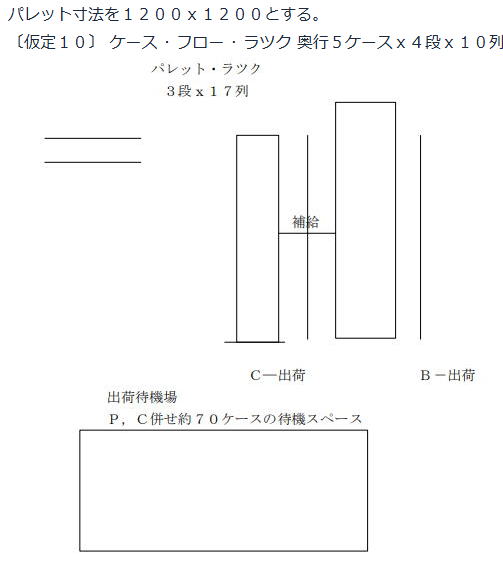
Conclusion on the Basic System: The storage area is divided into "Reserve Storage" (for replenishment) and "Active Storage" (for picking lines). Specifically, the basic system for this center combines pallet racks for reserve storage and case flow racks (with a depth of several pallets) for active storage.
VII. Piece (Bara) Shipping
-
Inventory Volume and Storage Format: While case shipping itself is not high at 28 cases, the estimated inventory per item from IQ analysis is high. Storage is suitable for pallet units (pallet racks, etc.), with an assumed scale of "3 tiers x 20 rows = 60 pallets."
-
Characteristics of Shipping Composition: The top 4 items account for 55% of shipments, and the top 17 account for 96%. Almost all items are subject to pallet storage.
-
Picking System Selection: For the approximately 10 items requiring 1–5 cases of piece picking, case flow racks are recommended for efficiency.
-
Basic System Conclusion: The system will utilize pallet racks for reserve and case flow racks for active picking.
VIII. Basic System for EX0
The basic system for EX0, based on the above assumptions, consists of a pallet rack reserve and a case flow rack system. The number of bays for these storage methods should be re-examined using several days and one month of EIQ analysis data. However, since EIQ data fluctuates, it cannot be determined by exact figures. It is best to decide "appropriately" (using the "good enough" method) while considering building space and margins.
IX. Layout Diagram
(Image: image21.jpg)
X. Alternative Proposals
The layout diagram in Section IX is just one example. Various plans are possible, such as arranging pallet rack bays in two facing rows or considering a layout based on the existing building structure.
XI. Operational Methods
-
As seen in the EQ-PCB analysis (Table 11), single picking is efficient because the order quantity per customer is high and consists of a small variety of items.
-
8 out of 12 customers order both cases and pieces. Cases are picked from the pallet rack reserve, and pieces are picked from the case flow racks, then consolidated by customer in the shipping staging area.
XII. Alternative Proposals (Comparison)
While the original proposal is the basic system derived from EIQ analysis results, the following alternative is often used in practice. It is useful to compare it with the basic system.
In the EX0 example, the difference in quality may not be significant due to the small scale, but as the number of items and shipping volume increase, the difference becomes clear.
-
Alternative Proposal: A plan to perform both case and piece picking directly from pallet racks used for pallet storage.
Many distribution centers use this alternative, but the basic system (the original proposal) offers better picking efficiency. Especially when the number of items and piece-picking volume are high, the basic proposal should be the primary consideration.